What Are Drop Ceiling Speakers and How Do They Work?
Drop ceiling speakers are audio drivers mounted above a suspended ceiling, with sound passing through a visible grille into the room. You may see them in offices, classrooms, shops, and homes where floor space is limited. From below, the installation can look almost invisible. Above the tiles, however, the speaker needs a suitable opening, secure support, and enough clearance for its enclosure and wiring.
How do drop ceiling speakers work? An amplifier sends an audio signal through speaker wire to the driver. The driver converts that electrical signal into vibrations, moving air to create sound. The grille protects the speaker while allowing sound through. Some models include a backcan, which helps contain sound and can improve consistency between rooms. The ceiling itself also affects what listeners hear. Tile material, room size, placement, and background noise all matter. A speaker that sounds clear in one room may seem thin or uneven in another.
Planning matters. Measure the ceiling grid, check the speaker’s dimensions, and confirm that the ceiling structure can support the installation. Follow the manufacturer’s instructions, especially when selecting compatible amplifiers and wiring. For fire-rated assemblies or unfamiliar electrical work, consult a qualified installer and the relevant product documentation. Small details count. A poorly supported speaker may rattle, while careless placement can leave quiet spots near desks or seating. And the “invisible” look is not always perfect: grilles remain visible, and sound quality depends on the room. Understanding these basics makes it easier to choose, place, and evaluate drop ceiling speakers with realistic expectations.
What Drop Ceiling Speakers Are
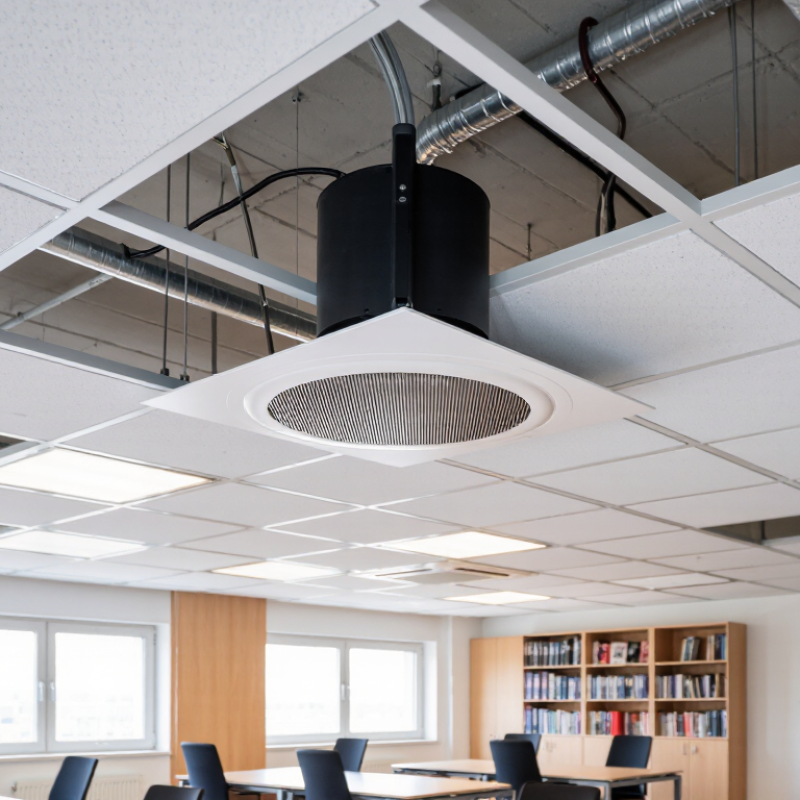
Drop ceiling speakers are loudspeakers fitted into a suspended ceiling’s metal grid, usually in place of a ceiling tile. Their visible face is a grille; the driver and supporting frame sit above it, in the ceiling void. Some models include an enclosure to control sound leakage and protect the speaker. Others use the space above the tile, so installation conditions matter.
The U.S. Energy Information Administration’s 2018 Commercial Buildings Energy Consumption Survey counted about 5.9 million commercial buildings, covering roughly 97 billion square feet. The survey does not track speaker installations, but it shows how many indoor spaces may use suspended ceilings.
In offices, classrooms, and shops, a speaker’s audio signal moves its cone back and forth, pushing air to create sound. Simple physics. The grille mainly protects the driver; it does not create the sound. Ceiling tiles can also absorb or reflect audio, so the same speaker may sound different in two rooms.
That part is easy to overlook. Placement, ceiling height, room noise, and the space above the tile all affect clarity. For reliable planning, installers check the speaker’s rated power and impedance, along with the ceiling structure and ventilation. A neat, flush finish is useful, but it does not guarantee even sound coverage.
The Main Components Inside a Drop Ceiling Speaker
A drop ceiling speaker is a compact loudspeaker mounted in a suspended ceiling. Its visible grille hides the parts that shape sound. The woofer moves air to reproduce lower and midrange frequencies; a smaller tweeter handles higher notes. A crossover divides the audio signal between them. Small parts matter. The baffle holds the drivers in place, while the grille protects them and lets sound pass. Some models also include a rear enclosure, which limits sound leakage into the ceiling cavity.
Look for a transformer in systems using 70- or 100-volt audio lines. Its taps let installers match speaker power to an amplifier and set relative output. Other systems connect directly, often using a stated impedance such as 8 ohms. These figures are not interchangeable; check the system design. IEC 60268-5, the international loudspeaker measurement standard, covers parameters including frequency response, sensitivity, and impedance. Those measurements help compare performance, but they cannot fully predict how a speaker sounds in a room. Ceiling height, insulation, and nearby hard surfaces all matter. A tidy specification sheet can still leave questions. When inspecting a unit, check the crossover, driver condition, connection terminals, and any enclosure—not just the grille.
How Audio Signals Become Sound in a Room
A drop ceiling speaker turns an electrical audio signal into moving air. Music or speech starts as a digital file, radio broadcast, or other source. A processor may adjust its level or tone. An amplifier then sends a changing electrical current through speaker wire to the ceiling unit. That is the chain.
Inside the speaker, the current flows through a voice coil near a magnet. The changing magnetic force moves the coil and attached cone back and forth. The cone pushes and pulls nearby air, creating pressure waves that travel to listeners’ ears as sound. Faster changes create higher pitches; larger movements generally produce louder sound. The speaker’s grille lets sound pass while protecting its components.
The room shapes what people hear. A speaker above a hard floor may sound different from one above carpet, and nearby walls can reflect sound. The ceiling cavity is not a perfect box, either. Its depth and insulation can affect resonance, especially with lower notes. Placement, speaker spacing, amplifier settings, and compatible electrical ratings all matter. Small details matter. In practice, even carefully chosen equipment can sound uneven if speakers are too far apart or aimed poorly. Listening from several seats helps reveal those gaps before the installation is considered finished.
What Are Drop Ceiling Speakers and How Do They Work?
How audio signals become sound in a room
An audio signal drives a speaker’s voice coil, moving its cone to create sound waves. This chart shows how wavelength changes with frequency, calculated using a speed of sound of 343 m/s. Lower-frequency waves are longer and can interact with a room differently from shorter, higher-frequency waves.
Where Drop Ceiling Speakers Are Used and What to Consider When Choosing Them
Drop ceiling speakers sit within suspended ceiling grids and send sound down through discreet openings. In offices, classrooms, clinics, shops, and restaurants, they can carry speech or background audio without using wall space. They work well where wiring can run above the tiles and listeners are spread across a room. Not every room agrees. Hard floors, noisy ventilation, and high ceilings can make voices muddy, even with several speakers installed. A short listening test in the finished room can reveal problems that a floor plan misses.
When choosing speakers, check their coverage pattern, power requirements, and compatibility with the amplifier. Wide coverage may suit a small meeting room, while a long corridor may need closer spacing. Measure the ceiling grid and check whether a backcan or support bridge is needed; the tile alone may not safely support the speaker. In areas with insulation or shared air spaces, confirm that the speaker assembly is suitable for the installation and meets applicable building requirements. Also consider moisture, cleaning access, and future tile removal. A common oversight is placing speakers above lights or air vents, where sound can be uneven. The layout may look tidy on paper and still need adjustment.